Infectious disease modelling with SEIRV
January 01, 2021
•
epidemiology
mathematical modeling
interactive
About this model
This interactive demonstration uses the SEIRV compartmental model to simulate the spread of an infectious disease. The model divides the population into five groups and tracks movement between them over time.
Adjust the parameters to see how different vaccination rates or disease characteristics affect the outbreak trajectory.
Interactive Model
Loading visualization...
Mathematical introduction
Infectious disease modelling informs decision making during disease outbreaks. I imagine this topic is now a canonical example in courses on mathematical modeling. The following set of ordinary differential equations describe an SEIRV model: susceptible, exposed, infected, recovered, vaccinated. $$ \begin{align*} \frac{dS}{dt} &= \mu N - \frac{\beta S I}{N} - \mu S - \kappa S &\quad \frac{dE}{dt}&=\frac{\beta S I }{N} - \sigma E - \mu E &\quad \frac{dI}{dt} &= \sigma E - \mu I - \gamma I \\ \frac{dR}{dt}&=\gamma I - \mu R &\quad \frac{dV}{dt} &= \kappa S - \mu V \end{align*} $$ These equations are more intuitively understood by considering the following diagram, showing the movement of people between groups: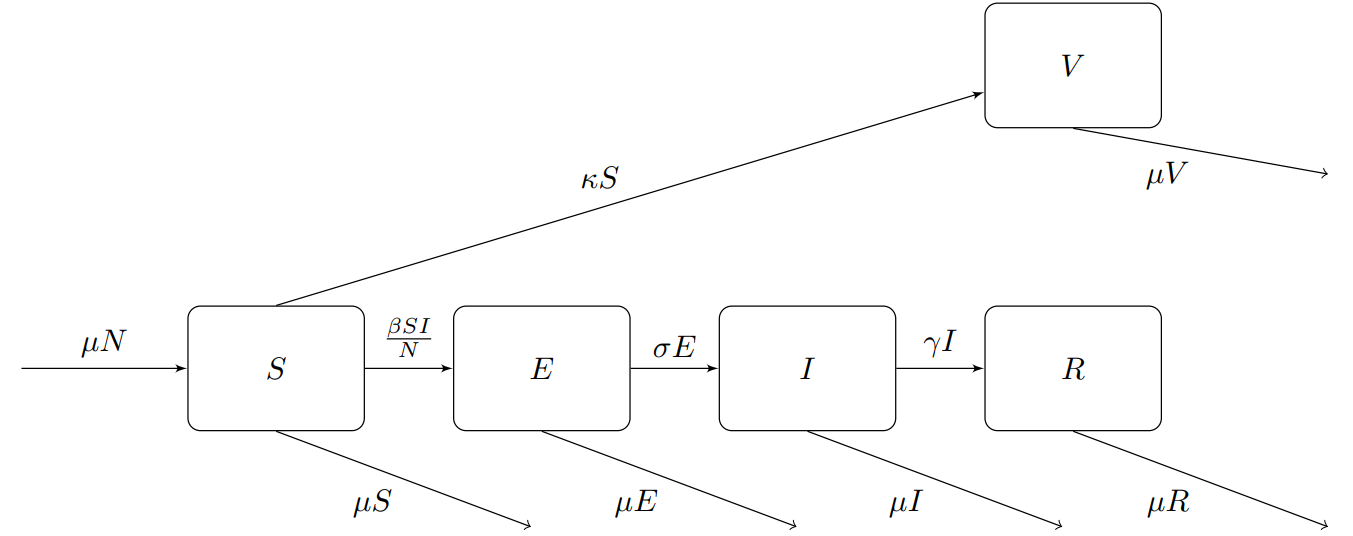
SEIRV flow diagram
This diagram shows the movement between groups.
People start out as susceptible to the disease. This group increases through additional births $\mu N$, and decreases as people move to other groups.
Being vaccinated or leaving this group via death depends on the population of this group and rates $\kappa$ and $\mu$, while becoming exposed depends on some rate $\beta$ and the proportion of the population who are infected $I /N$.
Hence, the term $\beta S I / N$ is added to the exposed group. Leaving the exposure group occurs at rates $\sigma$ for infection and $\gamma$ for death.
After exposure people become infectious at rate $\sigma$, and then there is a recovery rate $\gamma$.
Some simplifications in this model include: the rate of births is equal to deaths, the death rate is the same for each group ($\mu$), only people who are susceptible are vaccinated (at a rate of $\kappa$), and people who have recovered cannot be re-infected. Such a model will be appropriate for modelling some diseases but would need modification for others.
Some simplifications in this model include: the rate of births is equal to deaths, the death rate is the same for each group ($\mu$), only people who are susceptible are vaccinated (at a rate of $\kappa$), and people who have recovered cannot be re-infected. Such a model will be appropriate for modelling some diseases but would need modification for others.